Showing posts with label multifamily investing. Show all posts

Tuesday, February 9, 2016

Record Multifamily Investment

According to research from CBRE, investment in U.S. multifamily reached $127 billion for the year ending Q2 2015 - the highest four-quarter total in history and growth of 36% over the 12-month period. The total surpasses the mid-2000s peak of $100 billion achieved in the year ending Q2 2006.

Investment in multifamily communities has been robust for several years and this trend continued during Q2 2015, with $30 billion flowing into the sector. The quarter's total reflects a 35% gain over Q2 2014, although a slight decline from Q1 2015 (-3%). Multifamily acquisitions represented 27% of the total $110 billion invested in U.S. commercial real estate in Q2 2015.

The Los Angeles-Southern California area attracted the most multifamily investment in H1 2015 at $5.3 billion ahead of Dallas/Ft. Worth ($3.0 billion), Washington D.C. ($3.0 billion), Atlanta ($2.8 billion), and Houston ($2.5 billion).

Cross-border investment in U.S. multifamily totaled $2.1 billion in Q2 2015 (not counting properties acquired through entity-level acquisitions). The H1 2015 total of $4.4 billion is already higher than the full-year 2014 figure of $3.7 billion. Mexico represented the largest country source of cross-border acquisition capital for multifamily investment (31%), due to a significant portfolio transaction, ahead of Canada (29%).

"Investment in U.S. multifamily product continues its extraordinary run, reflecting solid confidence in future market and asset performance. Drawn in by solid fundamentals, investor interest in the sector remains high, per sales activity and underwriting trends. Equity and debt investment volumes continued to rise, along with transaction sales prices. Cap rate declines have been minimal, which signal total projected investor returns are close to bottom," said Brian McAuliffe, Executive Managing Director, Institutional Properties, CBRE Capital Markets. 
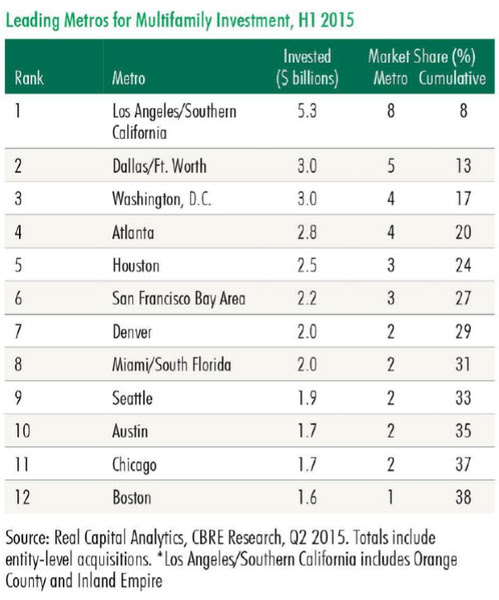
WPJ News | Leading United States Metropolitan Areas for Multifamiliy Investment H1 2015Demand for apartments is unrelenting as new supply has been swiftly absorbed. As a result, the average apartment rent across major U.S. markets is increasing at a pace far above the inflation rate, and the vacancy rate is at its lowest point in nearly 15 years.

Rent growth was widespread in Q2 2015, with 30 of the 62 markets tracked by CBRE posting year-over-year rent increases of 5% or more. The apartment vacancy rate across these markets was 4.3% in Q2 2015--down 30 bps from a year earlier and down 300 bps from the Q1 2009 recessionary peak of 7.3%. Vacancy is expected to continue to decline through the end of Q3 2015. 

Almost 70,000 apartment units were completed within the 62 major markets during H1 2015. If deliveries continue as forecasted, the 2015 total will reach nearly 173,000 units--while less than last year's 181,000 units, the total is more than any other year since 2000.

"Accommodative economic conditions and employment growth will support further strengthening in multifamily fundamentals in the near-term. Demographic trends--including the 30-year low home ownership rate of 63.5% suggest that the apartment sector will continue to absorb new deliveries over the next two years." said Peter Donovan, Senior Managing Director, Multifamily, CBRE Capital Markets.

Happy Investing!

Today's blog courtesy of Corey Crain, Keller Williams Commercial

Monday, November 2, 2015

Macro Economic Conditions

Expanding payrolls, solid consumption growth and housing market momentum support economic landscape. Against this backdrop, the Federal Reserve anticipates lifting its benchmark rate for the first time in more than nine years during 2015, though a move may not occur until next year. The imminent increase in the Fed Funds rate has raised questions among commercial real estate owners and investors regarding its potential effect on borrowing costs, spreads and asset valuations. However, the relationship between rising interest rates, a strong economy and continued vitality in commercial real estate seems quite compatible.
Read more here.  

In this context, where are investors finding the best real estate investment strategies? I've been told that commercial real estate follows a ten year cycle: For six years it is all about apartments and multifamily, for two years it is all about condos, and for two years, it is all about playing golf. 

I think we may be in the playing golf phase right now....What do you think, dear blog readers? Leave your thoughts and comments here at this post.

Happy Investing! 


Saturday, February 16, 2013

Multifamily Investment Trends

Next up on the NAREIA cruise was a panel of multifamily investors. Re/Max wanted NAREIA to write curriculum for working with investors, as it is now a landlord's market. Rebecca MacLean presented slides on "To Rent or Not to Rent." Many baby boomers are ready to downsize and not wanting to buy again. Gen Y has a lot of student debt and job insecurity; they are doubling up with housemates as rental rates go up. Gen Y is less likely to buy and more likely to move for new jobs. Anthony Chara owns 9 SFRs and 1300 units. During the pre-bubble, he found it easy to find renters, long-term renters until 2010-11. But now he is finding so many new rentals in volatile markets like Vegas and Florida that make it difficult to find stable renters. Prokash, a building contractor in LA since 1995 owns 45 units in ten buildings; most of the rentals are Section 8. After bubble, many investors have moved into rental market to rent to Section 8. Rents had to be reduced. Biggest problem is getting capital to build. He has been setting up limited partnerships to provide financing (20/80% each partner in). Darrin Carrey owns 45 units in Dayton, OH. Stable rents there , but starting to see rents go up in nicer areas. Today he finds it easier to find qualified tenants. Laura See, Chicago, owns 260-300 units in nice locations. Rents never dipped, but quality of tenants has improved. 0% vacancy rate currently. Her rentals are mostly condo and commercial townhomes, all higher-end, more professional tenants. Anna Mills, 37 years as contractor, investor, owns over 50 SFRs and small multis. She does her own rehab, repair, and management. The quality of her tenants has improved in suburban school districts. No vacancies in 2 1/2 years. General comments were that landlords were not worried about tenant credit ratings. There is a different market for small multis vs SFRs such as allowing pets, parking, lesser rules. Class A do rent concessions, but B&C take less-perfect tenants. Different markets. No hard crimes, out of all properties. Lower quality tenants in apartments vs SFRs. Chara stated that he was getting rid of concessions on apartments now.Vegas is flooded with rentals and high unemployment rates. Phoenix and Nevada multifamily markets are great deals. Economic loss = concessions.

Wednesday, February 13, 2013

Multifamily Investing

Next up as a speaker on the National REIA cruise was multifamily investor Anthony Chara. Anthony Chara has been investing since 2000 as a successful apartment investor with 1300+ units; He found a mentor in metro Denver who owned 450 units; he receives $140K/mo passive income; and teaches students long-term strategies. Average appreciation on his properties equals 5% per year through forced appreciation. His definition of cap rate = what property pays you if you buy all cash; aim for 8% or more, at least 2 points higher than the cost at which you can borrow money. 70% of commercial loans are upside down in the US. These cannot be refinanced; $1.3 trillion of commercial loans. Chara and a student set up a $5M fund to take advantage of underwater commercial loans. Most lenders require a capital reserve account upfront at closing; either an escrow capital reserve account where the lender will pay capital expenses or you will be reimbursed once per quarter. Chara listed the best ways to find properties as follows: Buy the first one in a particular market (you will be solicited to buy more) Buy from another investor seller with multiple properties Loopnet, to find brokers Create a personal relationship with commercial brokers Chara focuses on very stable markets in the midwest and sunbelt. Management of properties, finding a competent property manager, is critical. He recommends contacting irem.org or ccim.com and look for a cpm (certified property manager). Typically, 15-50% is required for an apartment down payment. Chara sees maximum cash flow from midwest to southeast, and focuses on areas that Chara wants to travel; Florida, Nevada, Arizona, where he is buying B and C properties. I asked about volatility of cap rates in some markets, which sparked quite a discussion. In my next blog post, I will provide a better explanation of what cap rates are, how they are determined, and how they are used to determine value for income properties like apartments.

Sunday, April 15, 2012

Rent vs. Buy???


It is likely that more people will be taking a shot at buying a home, with home ownership regaining its appeal as rents head higher. A recent article at CNN Money states that rents will rise over 7% in the next few years and climb thereafter mainly due to the echo boomers electing to not purchase homes.

A real estate research firm reported average apartment rents UP 2.7% last year, while the national vacancy rate went below 5% for the first time since 2001.

In addition, with little new residential and multifamily construction taking place, those displaced by foreclosure are added to the rental market mix.

Apartment rental costs have historically been about 10% lower than after-tax home ownership costs. That difference began shrinking in 2010 and now apartment rents are about 15% higher than home ownership costs.

Increasing rents, plus very affordable home prices and near record low mortgage rates, have made home buying cheaper than renting in most areas, spurring on first-time buyers.

Bottom line: this is an excellent opportunity to own real estate, whether it be a primary residence, single family or multifamily rentals.

Please contact me at 206-355-1706 or via email, if you would like to learn more about buying in today’s housing market.

Tuesday, November 22, 2011

Investing in Emerging Markets - FREE WEBINAR Today!


Hi! You are invited to join my FREE email mailing list for notification of real estate investment opportunities, both in Seattle and in emerging markets around the country. You are receiving this invitation, either because you expressed interest in real estate investing to me, you are a member of one of my local real estate investing groups, or you are a personal contact through my business networking in my database. If you wish to continue receiving newsletters like this, notifying you of local real estate investment opportunities, please opt-in using this form. Click on the link below to subscribe.

Thank you!
Wendy Ceccherelli
Designated Broker
Home Land Seattle

--
FREE email notification of investment opportunities:
http://eepurl.com/hciDo

Multifamily Investments

Join us for a Webinar this Tuesday November 22


Space is limited.
Reserve your Webinar seat now at:
https://www3.gotomeeting.com/register/993224638

We invite you to discuss the many advantages of Multifamily Investing and why Apartment Buildings are a great Investment for
todays economic conditions .
We will Discuss the Advantages of Multifamily Such as
Cashflow
Appreciation
Tax Benefits
Retirement Income
Hedge against inflation
And we will go over a current property we are working on in New Braunfels, TX.
Title: Multifamily Investments
Date: Tuesday, November 22, 2011
Time: 5:30 PM - 7:30 PM PST